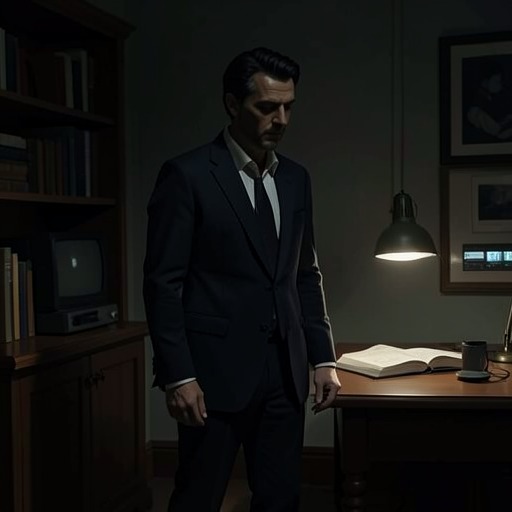
Mr. Ramsay’s Academic Self-Doubt
To the LighthouseMr. Ramsay’s Academic Self-Doubt is rendered as a crisis of thought and feeling: certain that he has reached Q, he strains toward R while imagining Z as a summit attained by almost no one. The alphabet turns intellectual progress into an ordeal of endurance, and his private fear of falling short becomes a family encounter when he seeks the sympathy of Mrs Ramsay and James. His ambition is neither simply mocked nor fulfilled; the passage gives it the scale of heroic struggle, then shows the intimate cost of requiring others to console the man who believes himself a failure.
The Alphabet as an Intellectual Landscape
Mr Ramsay measures the progress of thought against two ordered systems: a piano keyboard divided into notes and an alphabet of twenty-six letters. In either image, intellectual work proceeds through distinct stages rather than arriving all at once. He has reached Q, a point that already sets him apart from most people in England, but the next letter becomes a trial. He can demonstrate Q; R remains uncertain, and Z glimmers far ahead as a destination supposedly reached only once in a generation. The metaphor makes abstract intellectual achievement visible as a route with recognizable advances and an intimidating distance still to travel.
The passage distinguishes two kinds of intellectual power. One belongs to the plodding and persevering, who repeat the alphabet in order from A to Z; the other belongs to the inspired, who grasp all the letters at once in a flash of genius. Mr Ramsay does not claim the second kind. He believes he may possess the first: the power to proceed accurately through the whole sequence. Yet he remains stuck at Q. That gap between his acknowledged capacity for painstaking work and his inability to move on makes the crisis more than a simple judgment of ability: he can believe in the method and still fear that he cannot complete its course.
The Ordeal of Reaching R
Mr Ramsay braces himself to proceed, knocks his pipe against the handle of the stone urn, and tries to formulate R. The physical gesture gives the mental struggle a measured beat, but certainty does not follow. A shutter compared to a lizard’s leathern eyelid flickers across his gaze; in the resulting darkness he imagines people saying that he is a failure and that R is beyond him. The fear enters as a judgment he hears in that moment, not as proof that his work has failed. His thought turns uncertainty into a verdict before he can secure the next letter.
He summons endurance, justice, foresight, devotion, and skill, qualities likened to those needed by a ship’s company stranded on a broiling sea with six biscuits and a flask of water. The comparison gives his scholarly persistence the urgency of survival. Later, he draws on the steadiness of an imagined leader in the icy solitudes of the Polar region, who faces what is coming without being either sanguine or despondent. Yet neither heroic analogy carries him past the obstacle: his forehead veins bulge, the lizard-like flicker returns, and he remains at Q, pressing himself onward toward R.
The crisis expands into a vision of death before a mountain storm. Mr Ramsay imagines that, if he must die before morning, he would refuse to lie down; he would find a crag, stand with his eyes on the storm, and try to pierce the darkness to the end. In this imagined posture, intellectual persistence and heroic endurance become one: even if he never reaches R, he will not concede without a struggle. The scene does not resolve the academic problem. Instead, it dramatizes how deeply his sense of worth is bound to continuing the attempt.
Achievement, Fame, and Scale
The alphabet’s far endpoint makes Mr Ramsay consider how rare complete achievement might be. He asks how many men in a thousand million reach Z, then answers that perhaps one person in a generation does. Against that standard, he asks whether a person should be blamed for not being that one if he has worked honestly and given the best of his power until he has nothing left. The question shifts the measure of intellectual life from exceptional completion toward sustained effort, even as the image of the unreachable endpoint continues to govern his imagination.
His thoughts then move from achievement to posterity. He imagines fame lasting perhaps two thousand years, only to set that span against the ages viewed from a mountain top: even a stone kicked by a boot may outlast Shakespeare. His own small light, he concludes, would shine briefly and then disappear into larger lights. The grandeur of his imagined expedition is thus undercut by the enormous scale of time. Still, he squares his shoulders beside the urn and imagines being found dead at his post, a figure who has endured to the end. The self-dramatization is both a defense against inadequacy and an acknowledgment that effort cannot guarantee lasting recognition.
The Family Cost of Reassurance
Mr Ramsay’s inward crisis becomes an interruption in the relationship between Mrs Ramsay and James. James hates his father for coming up to them, stopping to look down, and demanding their attention. He resents not only the interruption but the magnificence of his father’s gestures and the emotional display that disturbs what James experiences as the simplicity and good sense of his bond with his mother. He fixes his eyes on the page and points to a word, hoping to make Mr Ramsay move on and bring Mrs Ramsay’s attention back. His strategy fails: Mr Ramsay remains where he is, asking for sympathy.
Mrs Ramsay responds by straightening herself while keeping her knitting in hand. The narration sets her energy, figured as a fountain or spray of life, against the image of male barrenness. Mr Ramsay says he is a failure; she counters by recalling that Charles Tansley considers him the greatest metaphysician of the time. But praise of his standing is not enough. What he wants is sympathy and assurance that he belongs at the heart of life, is needed, and can be welcomed into the living rooms and domestic spaces of the house. As she knits and laughs, she imagines those rooms furnished and filled with life, offering him the warmth and inclusion his intellectual struggle cannot provide.
The episode therefore makes the need for reassurance part of the meaning of Mr Ramsay’s academic self-doubt. His effort to reach beyond Q is presented with the solemnity of an expedition, yet its consequences arrive in the ordinary domestic scene: James’s page, Mrs Ramsay’s needles, and the father standing before them demanding recognition. Mrs Ramsay tries to convert intellectual defeat into a renewed sense of belonging, but James sees that his parents’ emotional exchange has disrupted the closeness he was enjoying. The passage holds both truths together: Mr Ramsay’s fear is genuine, and his way of seeking comfort imposes a cost on those he turns to for it.